Use cases Hardware startups
From a product idea to a reviewed system model
For founders and early engineers building a physical product while the architecture still lives in a pitch deck and a few people's heads. Cairn interviews you about the product, builds a first model of its parts, requirements and interfaces, and opens every AI change in Change Review before it applies.
The problem
In the first year, a hardware product is a pitch deck, a CAD assembly and a lot of decisions made in conversation. The requirements are in the deck, the mass and cost numbers are in a spreadsheet, and the reason the battery sits where it does is in someone's memory.
That holds until a design review, a supplier asking what the board has to survive, or a new engineer asking why the system looks the way it does. Then the answers have to be pieced together again, usually against a deadline.
A workflow in Cairn
Start from the pitch, not a blank page
Describe the product as you would to a new hire. The interview asks short rounds of questions and marks each answer You said or Assumed, so a guess about where the product is used never passes for a decision. Keep what holds, drop what doesn't, and build.
The interview →Choose the first parts yourself
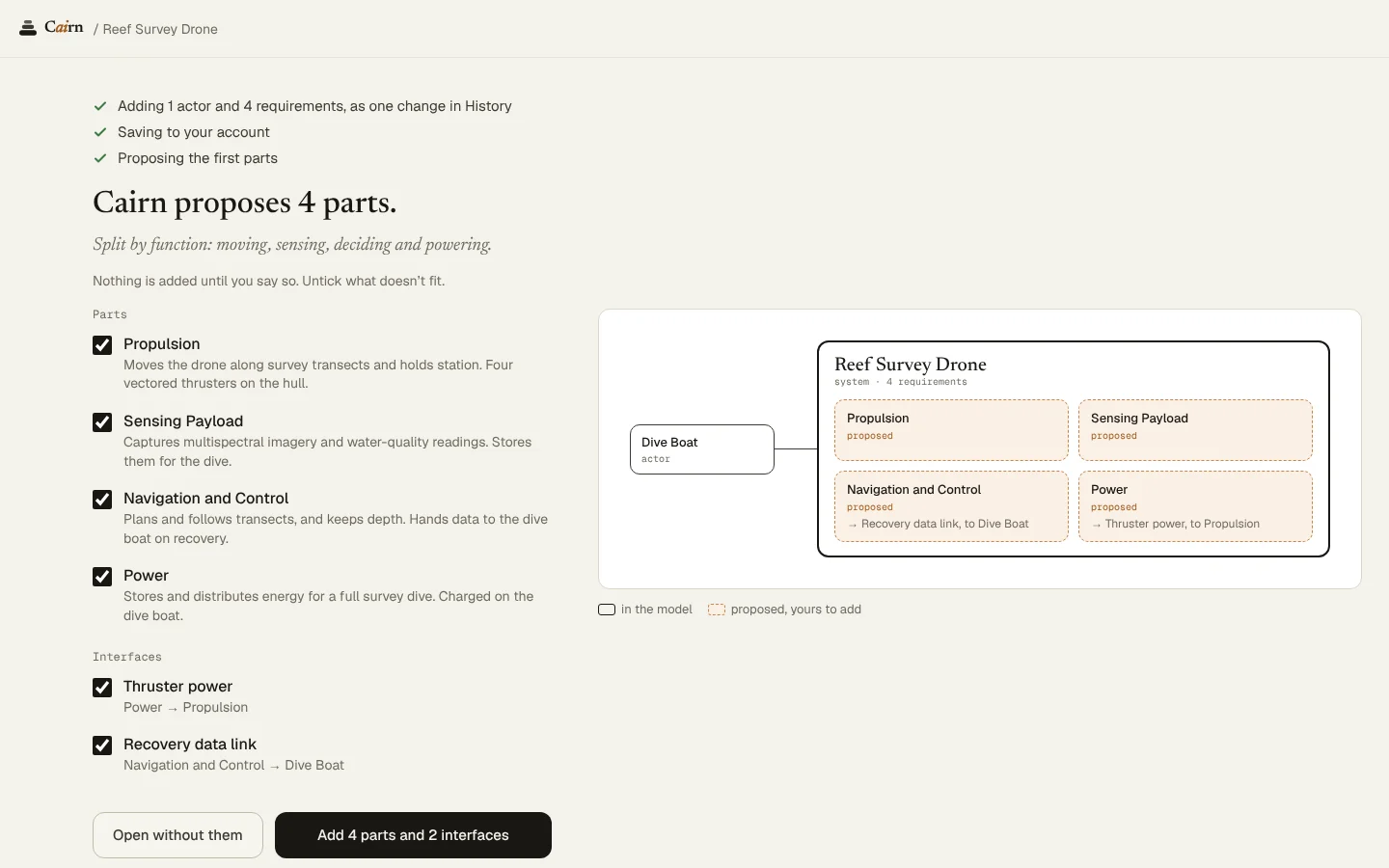
The Architect proposes the first subsystems and the interfaces between them: say a battery pack, a motor drive and a controller board. Tick the ones that match the product and leave the rest. Every later AI request opens in Change Review the same way, so nothing lands unreviewed.
System decomposition →Keep mass, power and cost against budget
Give each part its mass, power and unit cost, and set a budget on the product. Overview adds the parts up against each budget, so you see a design drifting over its target cost before you order boards.
System decomposition →Requirements a supplier can test
Ask for requirements on the parts that carry the most risk. Each arrives with a rationale and acceptance criteria, and wording checks flag words nobody can verify, such as "robust" or "fast", and a performance requirement with no number.
Requirements →Record why, not just what
When you choose a brushless motor over a geared one, keep the geared motor in the Dendritic lens as an alternative set aside, with why it lost. When the requirement behind that choice changes, the reasoning is there to revisit.
Design decisions →A record of every change
History keeps each change, yours or the AI's, with what it touched and why, and an Origin entry shows your interview answers and what each became. Undo one change, or restore the model to any point.
Change Review and History →
What Cairn doesn't do yet
- There is no shared workspace yet. A project lives in one person's browser and can back up to their account; a co-founder gets a copy by export (.cairn.zip) and import, and the two copies don't stay in step.
- Cairn doesn't connect to CAD, PLM or an issue tracker, and doesn't read or write SysML or ReqIF. The model comes out as JSON, Markdown or CSV.
- Cairn keeps the engineering model. It is not a compliance or certification record.
- Cairn is pre-launch and in early access.
Questions
- Can my co-founder work in the same model?
- Not at the same time. A project lives in one person's browser and backs up to their account. Export it as a .cairn.zip and they can import it, but from then on the two copies are separate.
- Does Cairn replace our CAD?
- No. Cairn holds the system model: parts, requirements, interfaces, behavior, verification and the decisions behind them. Geometry stays in CAD.
- Will the AI change the model without asking?
- No. Every AI proposal opens in Change Review, and nothing applies until you apply it. Any change can be undone from History.
See it on your own system.
Describe what you are building and Cairn interviews you, then builds the first model with you.